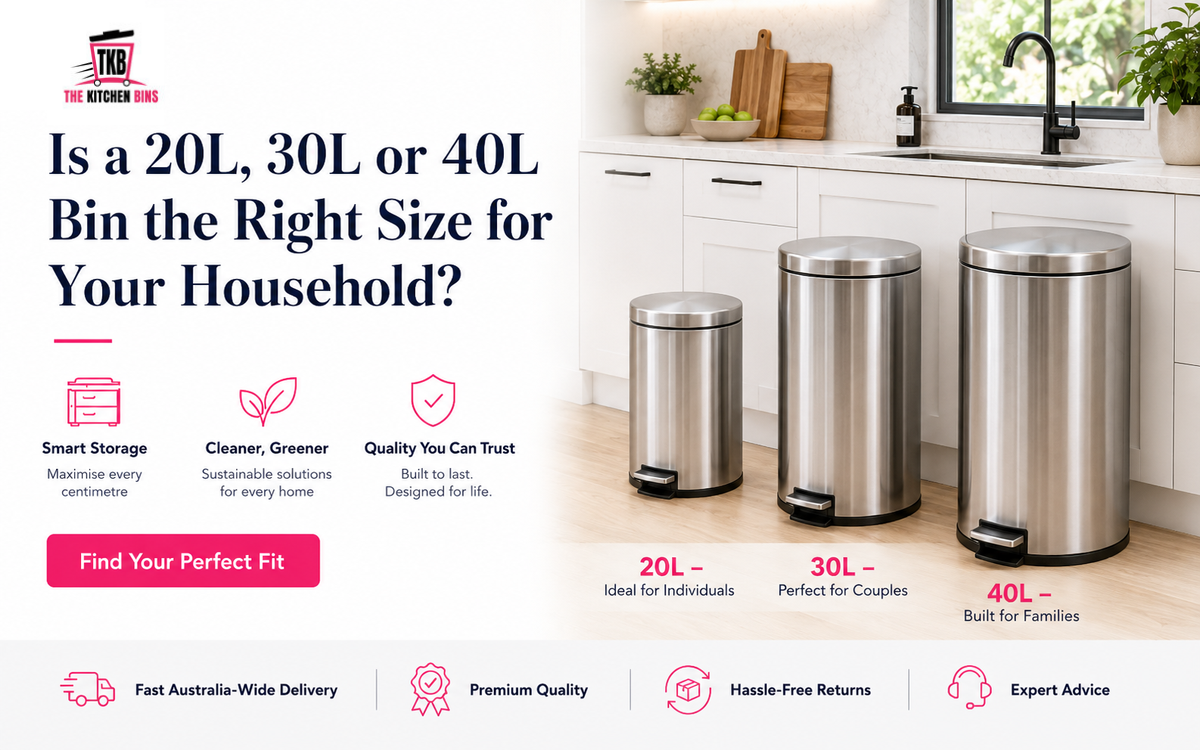
Choosing a kitchen bin by capacity sounds straightforward, but household size is only one part of the decision. Cooking habits, recycling, available cabinet space and how frequently rubbish is removed can all change what capacity feels practical.
A 20l bin can be perfectly adequate for one household and frustratingly small for another.
Think About How Much General Waste You Actually Produce
People often estimate capacity based only on the number of people living in the home.
That can be misleading.
A household that recycles heavily may produce much less general rubbish than another household of the same size.
A 30l bin can therefore be enough for some families even where a larger container might initially seem necessary.
When a 20L Bin Makes Sense
Smaller bins can work particularly well when rubbish is removed frequently.
They may suit:
- Smaller households
- Apartments
- Kitchens with limited cabinet space
- Households separating recycling
- People who compost food waste
- Secondary waste stations
Small Capacity Can Encourage Frequent Emptying
This is not always a disadvantage.
Food-related waste often benefits from being removed regularly rather than sitting inside the kitchen for long periods.
Check Liner Availability
Before choosing a 20l bin, consider what liners you normally buy and whether they fit comfortably without excessive material.
Where a 30L Bin Fits
A 30l bin sits between compact and large capacities.
It may suit households that want more room than a small kitchen bin provides without giving up too much cabinet or floor space.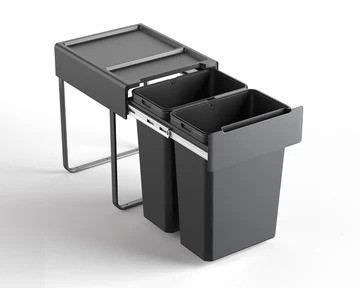
Consider Width as Well as Litres
Two bins with similar capacities can have very different shapes.
One may be tall and narrow, while another is shorter and wider.
Measure the space where the bin will sit rather than assuming capacity tells you the dimensions.
When a 40L Bin May Be More Practical
A larger household or a kitchen that generates substantial general waste may prefer more capacity.
A 40l bin can reduce emptying frequency, but it also takes more space.
Bigger Is Not Automatically Better
A large container has disadvantages if:
- Waste sits too long
- The bag becomes very heavy
- Cabinet space is limited
- Recycling already removes much of the waste
- The container is difficult to lift or clean
Think About the Full Bag
The question is not only whether the empty bin fits.
Imagine removing a completely full liner. Is there enough space to lift it out comfortably?
Cabinet Size Can Decide for You
Integrated kitchens often place stricter limits on capacity than freestanding arrangements.
Measure:
- Internal cabinet width.
- Depth.
- Height.
- Door opening.
- Plumbing.
- Removal clearance.
A 30l bin that fits comfortably may be more useful than forcing a larger option into an unsuitable cupboard.
Recycling Changes the Calculation
If general waste and recycling are separated, think about total system capacity rather than one container.
For example, two smaller bins may provide better organisation than one large bucket.
A household that produces large amounts of packaging could dedicate the larger compartment to recycling.
Emptying Frequency Is a Better Metric Than Household Size
For one week, observe how often your existing bin needs emptying.
If it fills every day, note whether the problem is true capacity or inefficient waste sorting.
If it takes many days to fill, a smaller bin may actually suit the kitchen better.
Match Capacity to Routine
As a rough decision process:
- Frequent emptying + limited space → consider smaller capacity.
- Moderate waste + average kitchen space → consider mid-range capacity.
- High waste volume + sufficient room → consider larger capacity.
These are practical starting points rather than fixed household rules.
Cleaning and Handling
Large bins take more effort to move and wash.
Integrated bins should have enough clearance to be removed from the cabinet.
Check whether the container shape is easy to wipe and whether any corners are difficult to reach.
Why Choose Us
Kitchen Bins offers kitchen waste solutions across different capacities, allowing households to select according to available space and everyday habits rather than relying on a single standard size.
Comparing dimensions alongside litre capacity can help reduce the risk of buying a bin that is technically large enough but inconvenient to use.
About Us
Kitchen Bins focuses on practical kitchen waste-storage solutions. We recognise that households vary in size, recycling habits, cabinetry and rubbish volume.
Our range allows customers to compare different capacities and configurations according to the way their own kitchen operates.
Conclusion
The 40l bin is not automatically better simply because it holds more.
A 20l bin may work efficiently for frequent emptying, while a 30l bin can provide a useful middle ground. Consider rubbish volume, recycling habits, cabinet dimensions and how easily a full liner can be removed before deciding which size belongs in your kitchen.